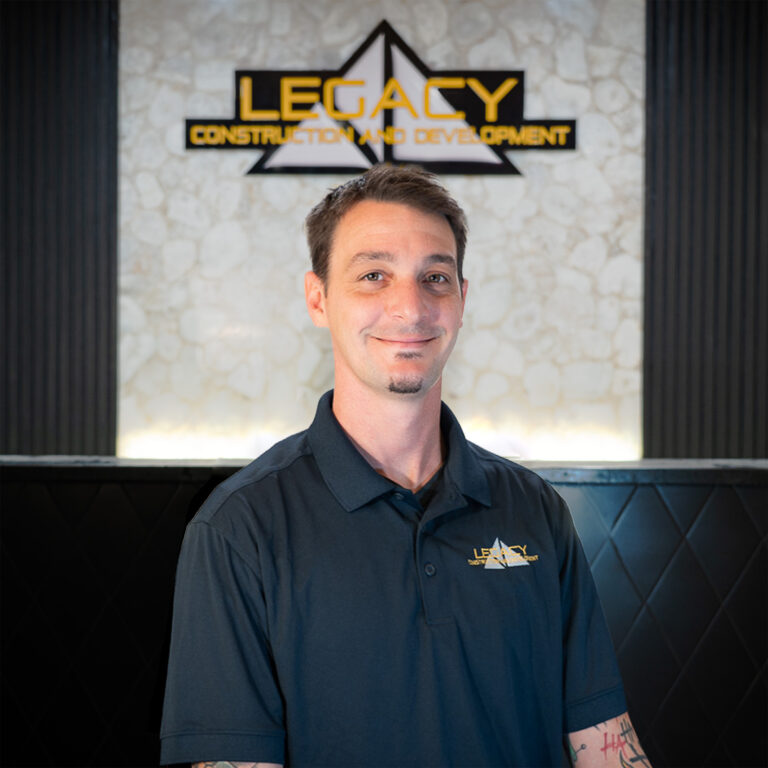
Legacy’s President of Business Operations and Co-Owner, Craig Wodehouse, shares his perspective on AI, where the construction industry is headed, and how Legacy is building technology that works alongside our people, strengthens our processes, and reflects the values that define who we are.
AI in construction is the future we are heading toward. It can be intimidating to the everyday user and even to experienced individuals in the construction industry. There is a natural uncertainty surrounding something that is changing so quickly. But once you begin to understand the capabilities of AI—and, more importantly, how those capabilities can actually apply to your business—that uncertainty starts turning into excitement. That is when the excited little kid comes out and your imagination starts to run wild with possibilities.
At Legacy Construction and Development, we have built our AI integration to work alongside us. From the beginning, we wanted something greater than a system that could simply answer questions. We did not want another chatbot or another piece of software employees had to learn how to operate. We wanted to build a system that could understand how Legacy itself operates—and, most importantly, how our people operate.
We pride ourselves on building the best team possible rather than fitting people into a finite box, which is how society often approaches employment. We take a different approach: give people room to create their own box, while operating within the parameters of our business and the values that define it—Willing, Relentless, Positive, Growth Mindset, Humble, and, last but certainly not least, Quality.
We wanted our AI to operate under that same philosophy.
That journey forced us to take a much deeper look at our own company.
Turning Tribal Knowledge Into a System
Developing our Operations Manuals and Standard Operating Procedures forced us to clarify processes, responsibilities, authority, and expectations throughout the organization.
You cannot write a good SOP without answering some very basic—but sometimes difficult—questions:
Who owns this process? Who has the authority to make the decision? What happens next? What information is required? When does something need approval? What happens when the normal process breaks? Who is responsible for fixing it? Most importantly, who is accountable for closing the loop?
Before documenting these processes, many of those answers existed informally. People knew how things were usually done, but that knowledge was spread across ownership, management, office staff, project managers, superintendents, estimators, emails, text messages, and individual experience.
That works until it doesn’t.
As a company grows, relying on individual memory and tribal knowledge becomes increasingly difficult. More employees, projects, clients, subcontractors, documents, financial transactions, and decisions create more opportunities for something to be misunderstood, forgotten, or lost.
Writing our manuals forced us to take what existed in people’s heads and turn it into an actual operating system for the company.
Giving AI a Constitution
Once AI becomes part of that operating system, SOPs alone are not enough. We needed to answer another question:
How is AI allowed to behave inside our company?
That led us to develop what we refer to as our Legacy AI Constitution.
In everyday terms, the Constitution establishes the rules and boundaries our AI operates within.
Normal employees have boundaries. Superintendents can make certain field decisions. Project managers have authority within their projects. Accounting has responsibilities and access that others do not. Certain decisions require ownership approval.
Our AI has boundaries as well.
The purpose of these rules is not to restrict AI’s usefulness. The rules actually allow us to give AI greater capabilities because we can define where its authority begins and ends.
There is a major difference between identifying a problem, recommending a solution, approving that solution, executing it, and verifying that it was completed correctly.
Our workflows recognize those differences.
The general philosophy is simple:
Observe. Understand. Recommend. Approve. Act. Verify. Record.
Some actions may require human approval. Others can eventually happen automatically because the rules, authority, and expectations have already been established.
The goal is not uncontrolled automation. It is controlled autonomy.
Why Did We Build It?
Why is AI important to us?
Because the goal was to build a system that understands how Legacy operates.
Traditional business software often forces people to adapt themselves to the software. Employees learn where to click, where information belongs, which spreadsheet needs updating, which email needs to be sent, and which system they need to check next.
We are attempting to reverse that relationship.
Instead of employees constantly operating the software, the software should help operate the business.
Our manuals tell the system how we operate. Our SOPs tell it how work should happen. Our Constitution tells it what is allowed. Our organizational structure tells it who is responsible and who has authority. Our workflows tell it what should happen next. Our data tells it what is actually happening right now.
AI becomes the reasoning layer connecting all of those pieces.
Turning Everyday Thinking Into Infrastructure
A surprising amount of running a construction company consists of small thoughts repeated hundreds of times:
Did we receive that subcontract? Is that subcontractor’s insurance current? Did someone follow up with that prospect? Has this invoice been approved? Did the superintendent complete the daily log? Where is the latest drawing? Was the change order added to the budget? Who is responsible for this? What still needs to happen?
Individually, these questions are simple.
Collectively, they consume an enormous amount of human attention.
Accountability across an organization can be extremely time-consuming. AI gives us the opportunity to turn that everyday thinking into infrastructure—a form of continuous background coordination.
The system can understand what was supposed to happen, recognize what actually happened, identify the difference, and bring the right issue to the right person.
That means our people can spend less time remembering, searching, checking, transferring information, and performing repetitive administrative work—and more time actually building, managing, solving problems, developing relationships, and making decisions.
That is where AI begins to become seamless.
What Does Success Look Like?
Success is not our AI being able to answer every question.
It is not about having the fanciest AI model or automating everything simply because we can.
Success is when the company stops depending on people remembering how the company works.
The knowledge, responsibilities, processes, approvals, documents, history, and expectations become institutional rather than individual.
But success goes beyond teaching AI how Legacy operates. It means teaching it what Legacy stands for. Our core values—Willing, Relentless, Positive, Growth Mindset, Humble, and Quality—should guide our AI just as they guide our people.
Our AI should be willing to assist wherever it can, relentless in following work through completion, positive and solution-oriented when problems arise, continuously learning with a growth mindset, humble enough to recognize the limits of its knowledge and authority, and always committed to quality in the work it produces.
Success is not simply having AI that knows Legacy’s rules. Success is having AI that operates in a way that reflects Legacy’s values.
An employee should understand what is expected of them. A manager should know what requires attention. Ownership should be able to understand what is happening without constantly chasing information. Routine work should happen with minimal friction, while exceptions and important decisions are brought to the appropriate person.
Ultimately, we are taking the knowledge, judgment, structure, and operating discipline that normally live inside a handful of experienced people’s heads and turning them into a living company operating system—one that can understand what is happening, help people execute the process, catch what gets missed, preserve institutional knowledge, and progressively automate the work humans should not have to spend their time thinking about in the first place.
For us, that is the real opportunity of AI in construction.
It isn’t about replacing the people who run the business. It is about building a business and culture where technology allows those people to spend more of their time doing the things that actually require people.
Learn more about how Legacy brings this same commitment to accountability, communication, and quality to every commercial construction project.